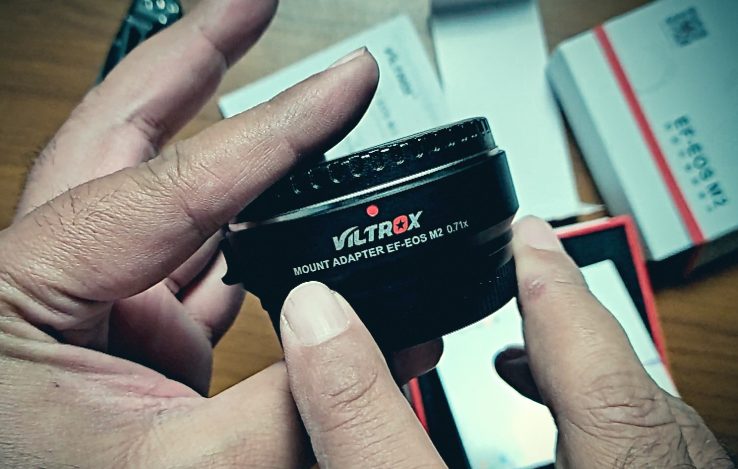
If you’re shooting on a Canon M50 and wishing your full-frame EF lenses were a stop faster, there’s a cheaper fix than buying new glass: a speed booster. I picked up the Viltrox EF-M2 adapter to test exactly this — using my existing EF lenses on the M50’s crop sensor while getting more light and a shallower depth of field out of them.
How a speed booster actually works
A speed booster (sometimes called a focal reducer) sits between your lens and camera body and optically compresses the image circle from a full-frame lens down to fit a crop sensor. The Viltrox does this at a 0.71x reduction factor, which has two effects at once: it widens your effective focal length back out (partially undoing the M50’s 1.6x crop), and it gains you roughly one extra stop of light.
In practice, that means an EF 24-105mm F4L becomes something closer to a 17-75mm F2.8L equivalent on the M50. Similarly, a basic EF 50mm F1.8 nifty-fifty effectively performs like a 35mm F1.2 — a lens combo that would normally cost significantly more if bought outright in native form.
What you actually get
- Full autofocus and electronic aperture control retained (this isn’t a dumb adapter — it passes through AF and aperture commands)
- A full stop of extra light, useful in dim conditions or for more subject separation
- A cheaper path to “fast glass” results using lenses you may already own
The tradeoffs worth knowing
It’s not entirely free performance. Speed boosters can introduce some softness or vignetting wide open, especially with lenses that weren’t optically designed with a reducer in mind, and the adapter itself adds cost and another mechanical connection point that can occasionally cause autofocus quirks. It’s not going to fully replace a native L-series prime, but for the price, it gets you meaningfully closer.
Is it worth it?
If you already own EF L-series glass (or budget primes like the 50mm F1.8) and shoot on a crop body like the M50, this is one of the best value upgrades you can make without buying a new lens. If you’re starting from scratch with no EF lenses yet, it’s a more situational recommendation — do the math on buying used EF glass + adapter vs a native EF-M lens for your specific case.